





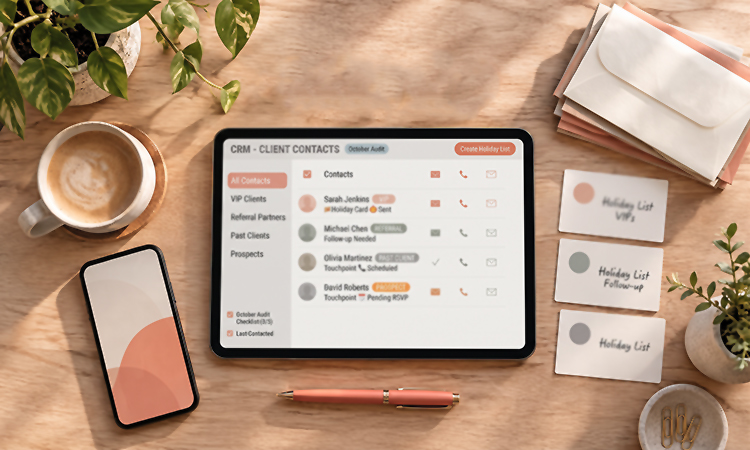
Last week, we talked about running a plan long enough to see how it actually handles the real world. Once things get moving, you start hearing the rattles, noticing the friction, and realizing what’s missing.
This week, let’s look at one specific part of that setup: your client relationship system.
November and December naturally open up opportunities to reconnect. We order holiday cards, check in with past clients, and send thank-you gifts to people who referred us business this year. But good intentions get derailed fast if your contact information is scattered across three notebooks, your phone’s camera roll, old email threads, and your own memory.
Here’s the real question: If you wanted to love on your people next month, could you actually do it without losing your mind?
Why Audit Your Client Relationship System Now?
It’s easy to assume a system works when it’s just sitting there untouched. You know you have a CRM, and somewhere in Google Drive, there’s a folder labeled “Holiday Campaign.”
Then November hits. You sit down to execute, and what should have taken an hour turns into a three-day project. Mailing addresses are missing. Cell numbers are outdated. Half your contacts aren’t tagged, so no one remembers who is actually a VIP. Instead of spending your energy having great conversations, you spend it cleaning up spreadsheets.
That’s why October is your best friend. It gives you room to catch the gaps before the holiday rush takes over. If your current system creates friction every time you try to reach out, it’s telling you where it needs attention.
Can You Find and Reach the Right People?
Start with the basic mechanics. Can you pull up the exact group of people you want to reach without opening four different apps?
Take a quick inventory. Have you clearly tagged your:
- VIP clients and top advocates
- Active referral partners
- Past clients
- Current active prospects
From there, audit the contact data itself: phone numbers, email addresses, and physical mailing addresses. You don’t need a 100% complete profile for every casual contact, but you do need to know where your blind spots are before you hit send.
Does Your CRM Support Real Relationships?
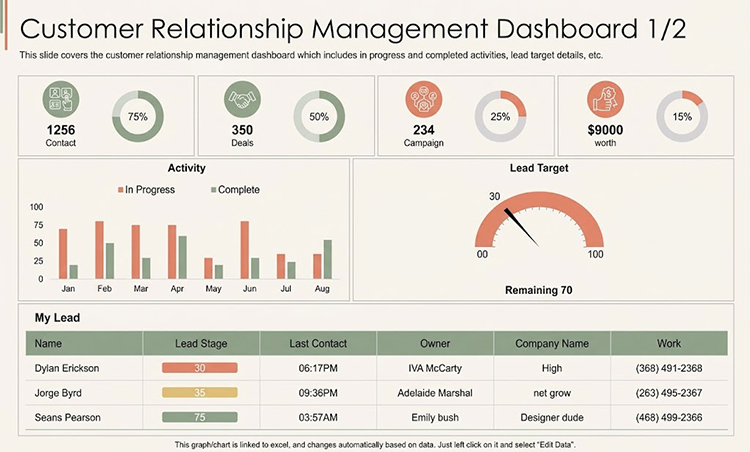
A CRM can hold 5,000 names and still be practically useless day-to-day. The real test isn’t storage, but clarity. Does your tool actually help you understand where a relationship stands and what to do next?
Ask yourself:
- Can you message a specific group without hand building a brand-new list every single time?
- Can you instantly see when a client last heard from you?
- Are your automated follow-up reminders actually firing, or did they quietly stop three months ago?
Technology shouldn’t get in the way of human connection. A system that is well designed gets out of your way so you can jump straight into genuine conversations and personal notes.
Working alongside agents and leaders at Epique Realty, I see this all the time: the heart to serve people is already there. A usable system just builds the bridge between wanting to stay in touch and actually doing it.
What Still Exists Only in Your Head?

Some of the most valuable business intel never actually makes it into a CRM.
You probably know off the top of your head which client prefers a phone call over a text, who just bought a new house, or whose kid just started college. You might also carry your entire follow-up routine in your head because taking the time to write it down has never felt urgent.
That works, until life gets busy. Eventually, your client care starts depending on how sharp your memory happens to be that Tuesday. And if you ever try to delegate a task, you end up having to explain every single small step.
As you look at your setup, notice what relies entirely on you.
- Which client details need to be logged permanently?
- Which repeated tasks belong in a standardized Playbook?
- What process have you been postponing documenting?
The goal isn’t to mechanize your relationships. It’s to stop preventable disorganization from getting in the way of showing real care.
How Can You Test the System Before the Holidays?
Right now, I’m integrating Thanks.io into my own workflow so direct mail becomes an automatic, seamless part of how I stay connected. But instead of waiting for Thanksgiving to see if my integrations work, I’m using October as a dry run.
A quick, low-stakes Halloween card is my practice lap. It forces me to verify my mailing list, check deliverability, and walk through the tool from end to end. If something breaks, I have plenty of time to fix it before the high-stakes holiday push.
Your test run doesn’t have to be direct mail. It could be:
- Sending a quick check-in email to a test segment of 10 people
- Running through one complete follow-up sequence in your Playbook
- Testing your broadcast text feature to make sure phone formats are correct
Pick one real action this week that forces your system to do what you built it to do.
Is the Whole Engine Built?
Doing a system audit isn’t about tearing everything down and starting over. It’s simply about spotting the missing links while you still have time to fix them stress-free.
Take a look across your database, messaging tools, content calendar, and follow-up workflows. Notice where work flows naturally and where it gets stuck in a bottleneck.
You don’t need a flawless setup to start reaching out because genuine relationships have never required perfection. But having the right structure behind you ensures your care remains steady, even when your schedule gets packed.
Run one small test this week. See what holds up and what needs a quick tune-up before you actually need it under pressure.
Stay connected with Dawn Loding for conversations around real estate abundance, aligned growth, and building a business that supports your life instead of consuming it. Through the Agents of Abundance podcast, the Facebook group, Epique Voices, and the Agents of Abundance community, you’ll find spaces designed to support meaningful growth, honest conversations, and a more sustainable way to succeed in real estate.