
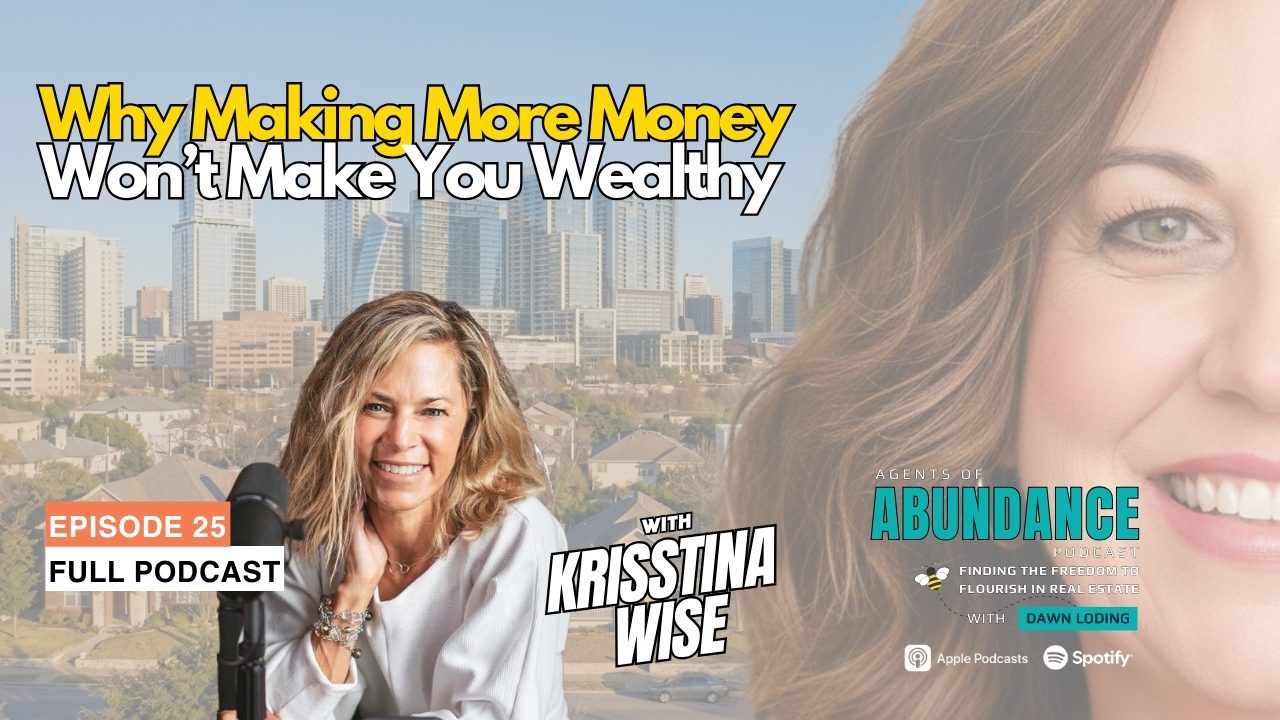

Real estate agents spend a great deal of time learning how to make more money. We study lead generation, marketing, negotiation, CRMs, and strategies for closing more transactions. We celebrate production numbers and commission checks, so when money feels tight, the answer often seems obvious: sell another house.
But earning more is not the same as building financial freedom. In this episode of Agents of Abundance, I sat down with entrepreneur, real estate investor, author, and wealth coach Krisstina Wise to explore what happens after we earn the money. Her story shows why a high income can still leave someone financially vulnerable and why true wealth requires us to make, manage, and multiply what we earn.
How Can a Successful Real Estate Agent Still Be Financially Insecure?
Krisstina understands what it means to succeed in real estate. She became a top producer, earned awards, and learned how to generate significant income. From the outside, her career looked exactly like the kind of success our industry encourages us to pursue. Behind closed doors, however, her finances told a very different story.
She grew up in a rural farming community where money was scarce. After her parents divorced, she experienced frequent moves, food stamps, and the stress financial instability placed on her family. Those early experiences connected money with insecurity and survival. They also fueled her ambition to create a different life, leading her to work hard and eventually find her way into real estate.
Krisstina became excellent at marketing, generating leads, holding open houses, and selling homes. What she had not learned was how to manage or grow the money she made. Her financial wake-up call came during her divorce. Her husband had handled the household finances, and when the marriage ended, she discovered that she had more than $100,000 in credit card debt and approximately another $100,000 in tax liens. She also needed to establish a home for herself and her children.
On paper, she was a successful real estate agent. In reality, she did not have the financial foundation that her income appeared to promise. That painful contradiction forced her to confront a truth many high earners eventually discover: income and wealth are not the same thing.
How Does Childhood Scarcity Shape Your Relationship With Money?
Money is mathematical, but our relationship with it is deeply emotional. Our earliest experiences can create beliefs and behaviors that stay with us long after our circumstances change. If money was associated with arguments, instability, shame, or fear when you were young, you may still feel anxious about it even when you earn well.
That anxiety can appear in different ways. Some people avoid checking their accounts or opening bills. Others spend quickly when a large commission arrives because they do not trust that money will remain available. We may worry constantly that it will disappear or convince ourselves that one more closing will finally make us feel safe.
This is why changing our financial lives often requires more than a new budget. We need to understand the emotions and old beliefs behind our decisions. Financial knowledge matters, but self-awareness helps us use that knowledge consistently rather than repeating the same patterns at a higher income level.
What Does It Mean to Make, Manage, and Multiply Your Money
Krisstina eventually began studying money with the same focus she had once brought to learning real estate. What she discovered was surprisingly simple: money has three distinct parts.
Make it. Manage it. Multiply it.
Most real estate agents understand the first part. We prospect, market, build relationships, sell homes, and earn commissions. We may also create income through investments, revenue share, coaching, or other business opportunities. The real challenge is recognizing that earning the money is only the beginning.
Managing money means knowing where it goes and making intentional decisions about it. It includes preparing for taxes, controlling expenses, eliminating destructive debt, and consistently creating a surplus. Multiplying money begins when we place some of that surplus into assets that can grow or produce additional income.
That shift changes the question from, “How can I make more money?” to, “How can I make the money I already earn work for me?” It is the point where wealth begins to separate from income.
Why Can’t You Simply Earn Your Way to Wealth?
This distinction is especially important in real estate because our income can fluctuate so dramatically. A large commission arrives, the bills get paid, and the pressure temporarily lifts. We may celebrate, upgrade something in our lives, or increase our monthly commitments. Then a slower month arrives while taxes, marketing costs, and personal expenses continue.
The pressure returns, and we decide that what we need is another closing. That cycle can continue even as annual income grows. The numbers become larger, but the underlying financial pattern remains unchanged.
Krisstina had to interrupt that pattern by dramatically reducing her lifestyle and committing to eliminating high-interest debt. It did not look glamorous, but it gave her a foundation on which wealth could grow. High-interest debt works against financial freedom because interest continues pulling money away while we work harder to earn it.
She also had to confront lifestyle inflation, which happens when spending rises alongside income. A larger house, nicer car, or more expensive vacation is not automatically a problem. The danger appears when our lifestyle grows as quickly as, or faster than, the income supporting it. Large commission checks can make us feel wealthier than we are, but looking wealthy and being wealthy are very different things.
What Principles Support Building Financial Freedom?
Krisstina describes wealth as something built through principles rather than luck. The mathematics are straightforward: earn money, spend less than you earn, remove harmful debt, create a surplus, and invest that surplus in assets that grow or generate income. Following those principles consistently changes your financial position over time.
The formula may be simple, but the behavior is not always easy. Fear, scarcity, comparison, lifestyle expectations, and old beliefs can all interfere. That is why building financial freedom requires both practical education and an honest understanding of ourselves.
. More production can be exciting, but abundance is not found in earning more only to remain trapped by financial pressure. The way we handle what we earn determines whether our success creates choices or simply more obligations.
What Is Your Good Life Number?
One of my favorite ideas from Krisstina is the Good Life Number. Many of us have been conditioned to chase more: more transactions, production, recognition, and income. Yet we rarely stop to ask how much is actually enough.
Krisstina encourages us to define what a good life means personally. Consider the home you want, the experiences that matter, how often you would like to travel, the time you want with family, and what you hope to give or contribute. Then calculate what that life actually costs.
That amount becomes your Good Life Number. Instead of pursuing an endless and undefined version of more, you begin building toward a life you have intentionally chosen. Your financial goals become connected to something meaningful rather than to comparison or industry expectations.
From there, you can calculate your Freedom Number, which represents the amount of invested wealth needed to generate enough income to support your good life. The goal changes again. You are no longer measuring financial success only by what you can earn this year. You are considering how much wealth you need to create so that your assets can eventually help fund your life.
Why Should You Make Financial Decisions for Your Future Self?
Real estate naturally encourages short-term thinking. We focus on what is closing this month, what is in the pipeline, and where the next listing will come from. Those questions matter, but wealth asks us to look further ahead.
Krisstina calls this future selfing. Imagine yourself 10, 15, or 20 years from now. What kind of life does that person want? What resources will they need? Which decisions would they wish you had made today?
Our future selves do not arrive with financial freedom by accident. The habits and choices we practice now create the resources they will eventually have. That might mean setting aside taxes before spending a commission, paying more than the minimum on high-interest debt, resisting an unnecessary lifestyle upgrade, or beginning to invest before we feel completely ready.
Why Does True Wealth Include More Than Money?
Krisstina eventually built extraordinary financial and business success, but then a serious health crisis removed her from her business for approximately two years. For years she had focused on financial, business, and investment assets. Suddenly, her body became more important than all of them.
The financial habits she had established gave her the space to focus on healing. Her investments and savings mattered enormously during that season, but money could not replace her health. The experience expanded her definition of wealth to include relationships, love, laughter, freedom, time, and the ability to enjoy what she had created.
That is an important reminder for anyone who has been so focused on success that the rest of life has begun to disappear. There is little abundance in having everything financially while losing the health, relationships, or time needed to experience it.
For Krisstina, financial freedom is not about never working again or buying everything she wants. It means not worrying about money. Her assets now produce enough cash flow to support her lifestyle, yet that freedom has not stopped her from creating. Instead, it allows her work to come from curiosity, purpose, contribution, and choice rather than survival.
How Can Real Estate Agents Start Building Real Wealth?
You do not have to transform your entire financial life overnight. Begin by getting closer to your money. Know what you earn, spend, owe, and need for taxes. Address high-interest debt, create a surplus, learn how investing works, and define what your good life actually costs.
Most importantly, think about who you are becoming financially, not only what you hope to earn next month. The goal is not perfection. It is awareness followed by intentional action.
For real estate agents, learning to make money is part of the job, but it should not be the end of the financial journey. Krisstina’s story shows what becomes possible when we pay attention to what happens after the commission arrives.
Make it. Manage it. Multiply it. Then use the freedom you create to build a life that feels abundant in money, health, relationships, time, and choice.
Resources:
WealthyWellthy: Krisstina Wise’s wealth education, coaching, and resources
Falling for Money: Krisstina Wise’s book exploring money, wealth, and financial well-being
Rich Dad Poor Dad by Robert Kiyosaki
Connect with Krisstina:
Connect with Dawn: