

For most of my life, I believed personal growth began with changing the way I thought. I read the books, attended Tony Robbins events, and studied mindset, leadership, productivity, business strategy, systems, and personal development. I learned how our thoughts influence our feelings, how our beliefs shape our actions, and how changing our thinking can change our results. That work mattered, and it still does. Yet even after decades of learning, I sometimes found myself asking a frustrating question: If I know what to do, why can’t I always get myself to do it?
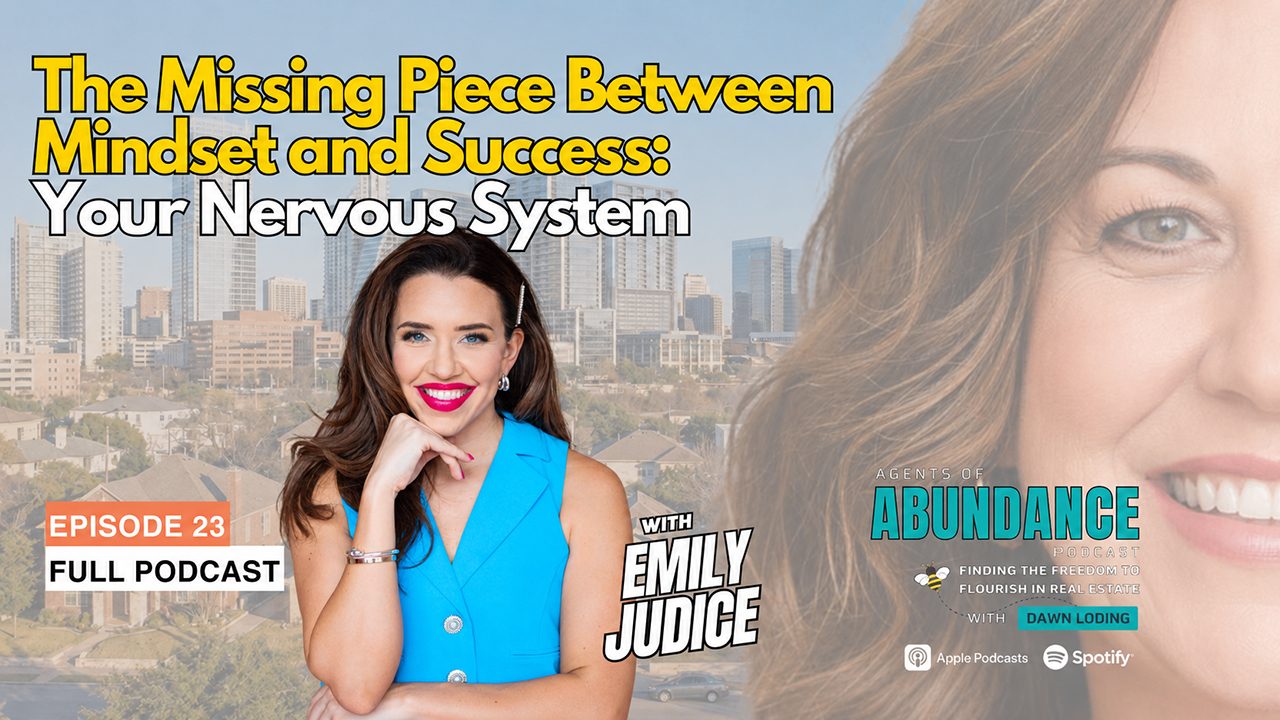
Working with Emily Judice helped me understand that there may be another layer beneath mindset and strategy. Emily is one of my coaches, and her work has changed the way I think about myself, my relationships, my business, and abundance. In this episode of Agents of Abundance, we explore how your nervous system can affect your ability to take action, receive support, manage pressure, and hold the success you say you want.
Why Mindset Work Is Not Always Enough
Emily understands the world of mindset coaching well. As a certified life coach, she spent years helping people examine their thoughts, feelings, and actions. Over time, however, she noticed a gap. People often knew what to do, genuinely wanted different results, and had access to good strategies, but still struggled to follow through consistently.
She experienced that gap in her own business. Emily invested in marketing, sales strategies, operations, coaching, and the tools she believed would help her grow. Still, her business remained stagnant for years because she could not consistently implement what she already knew. Eventually, she realized that we do not simply think our way through life. We experience life through our bodies, too.
That distinction matters for entrepreneurs. An unhappy client, a slow month, a listing that falls through, a difficult conversation, or a video you are afraid to publish can all trigger a response that has little to do with what you consciously know you should do. You may overthink, procrastinate, become perfectionistic, avoid the task entirely, or stay incredibly busy while never addressing the action that matters most.
Understanding Your Nervous System Through the Ocean Metaphor
Emily uses an ocean metaphor to make nervous system states easier to understand. Picture a sailboat moving peacefully across calm water. This represents the calm and connected state, also known as the ventral vagal state. In this state, you can think clearly, connect with other people, solve problems creatively, and make intentional decisions. Those abilities are essential when you are leading a business.
Now imagine the same ocean during a storm. Huge waves are coming toward you, and you are fighting to keep your head above water. This is the activated state most of us recognize as fight or flight. Many entrepreneurs spend a great deal of time here. We wake up and immediately check our phones, react to a client email, handle something with our children, address a contract problem, rush to an appointment, and move from one urgent situation to the next.
No one can fight the waves forever. Eventually, the system may move into shutdown, which Emily compares to sinking to the bottom of the ocean. You sit down to work but end up scrolling on your phone. You feel disconnected, procrastinate, or cannot seem to begin, even though you know something needs to be done. It is easy to label this as laziness or a lack of discipline, but another planner or productivity program may not solve it. Sometimes the real issue is that your nervous system has been overwhelmed for too long.
Your Capacity Can Grow
One of the biggest breakthroughs for me was learning that capacity is not fixed. As entrepreneurs, we carry clients, contracts, families, teams, leadership, marketing, finances, and hundreds of daily decisions. Eventually, we start saying, “I just don’t have the capacity for anything else.” Emily’s work does not suggest that we should tolerate endless stress or do everything ourselves. Delegation, better systems, and appropriate support still matter. The difference is recognizing that they are only part of the solution.
One of my favorite business mantras is “Systemize. Automate. Delegate.” I still believe in it completely. Real estate has too many moving parts to keep everything inside our heads. However, systems can support our capacity without automatically expanding it. If constant production is what makes you feel safe, you may simply fill every open space after delegating. Emily described herself as once being “addicted to chaos” because chaos was so familiar that calm felt uncomfortable. Creating white space on the calendar is valuable, but we must also learn to feel safe inside that space.
The same principle applies to receiving help. When I first hired support, I felt guilty paying someone to do tasks I could technically do myself. Today, I have had a housekeeper for years and work with multiple virtual assistants, but becoming comfortable with that support took time. If receiving help feels unsafe, you may hire an assistant and then micromanage, redo the work, or create more work while trying to manage them. Growing a business is not only about finding support. It can also require increasing your capacity to receive it.
Protector Parts Are Trying to Keep You Safe
Another concept from Emily’s work that has been transformational for me is what she calls protector parts. They may appear as control, overthinking, people pleasing, perfectionism, overserving, avoidance, detachment, or constant productivity. These behaviors can create problems, but they are not necessarily the enemy. At some point, they may have helped you feel safe. Perfectionism may have protected you from criticism. Keeping everyone happy may have reduced conflict. Controlling every detail may have made an unpredictable situation feel manageable.
Instead of asking, “What is wrong with me?” Emily encourages us to become curious. What is happening in my life right now? When have I felt this way before? What am I carrying, and what might this response be trying to protect me from? Curiosity allows us to understand a reaction without making it evidence that we are lazy, broken, or incapable.
This becomes especially important during a difficult business season. Imagine having no closings, losing a deal, and suddenly seeing an empty pipeline. The thought “My business isn’t working” can create a physical response, such as a tight chest, a pit in your stomach, or a racing mind at night. From that state, you may withdraw, avoid prospecting, stop creating content, compare yourself to other agents, or frantically chase a new strategy. The story begins influencing the very actions that make it more likely to continue.
Regulation Is Not About Avoiding Emotion
Emily makes an important distinction: regulation is not about making an uncomfortable feeling disappear immediately. It is learning how to stay with yourself while the feeling is present. Instead of escaping disappointment, fear, anxiety, or defeat, you notice how the emotion feels in your body and allow yourself to experience it safely. Walking, rocking, changing temperature, and engaging the senses are some of the physical tools that can help.
Once the intensity settles, you can examine the situation more clearly. Perhaps your entire business is not failing. Maybe you had one difficult month, the market shifted, or the work you are doing needs more time to produce results. An honest evaluation may also reveal that you have not been prospecting or building relationships as consistently as you thought. Regulation is not pretending everything is wonderful. It creates enough internal space to respond thoughtfully instead of reacting from fear.
For years, I have kept a question where I can see it: “Did this happen to you or for you?” That question has helped me look at difficult seasons differently. Emily shares a similar belief that challenges can refine us into the people we need to become. We can ask what an experience is teaching us, how it may prepare us to lead others, and who we are becoming as we move through it.
Can Your Nervous System Hold More Abundance?
This question sits at the heart of Agents of Abundance. We can consciously want more clients, money, leadership, freedom, and opportunity while still feeling unsafe receiving them. Emily once had a coach ask what would happen if 100 ideal clients arrived tomorrow. At the time, she realized the demand would crush her. She was asking for growth that she did not yet have the capacity to hold.
Instead of focusing only on how to attract more clients, Emily began becoming the person who could sustain that level of success, and her business eventually grew dramatically. Her story invites us to ask a different question. Rather than only asking, “How do I create more?” we can also ask, “Who do I need to become to safely hold more?”
Building capacity does not guarantee that life will become easy. There will still be challenging clients, market changes, family pressures, unexpected expenses, and plans that do not work. The goal is not to create a life where nothing goes wrong. It is to develop enough self-trust to know that whatever happens next, you can meet yourself there. When you trust yourself to handle the outcome, you become more willing to create, lead, receive, and grow.
Final Thoughts: The Missing Piece Between Mindset and Success
We spend so much time asking which strategy will take our business to the next level. Sometimes a better first question is whether we have the internal capacity to hold the life and business we are asking for. This does not mean abandoning mindset work, strategy, systems, or delegation. It means recognizing the layer beneath them.
Your nervous system influences whether you can use the strategies you already know, create while life feels uncertain, receive support, respond constructively to setbacks, and rest without immediately filling the space. Perhaps the next level of your business does not require you to work harder. Perhaps it requires becoming safer holding more.
Resources & Links
Emily Judice’s Nervous System Resources
Explore Emily’s current workshops, masterclasses, coaching programs, and nervous system education.
Emily Judice Podcast
Continue learning about nervous system regulation, personal growth, capacity, and creating sustainable success.
Agents of Abundance
Resources and community for real estate professionals who want to move from scarcity and survival into intentional, abundant leadership.